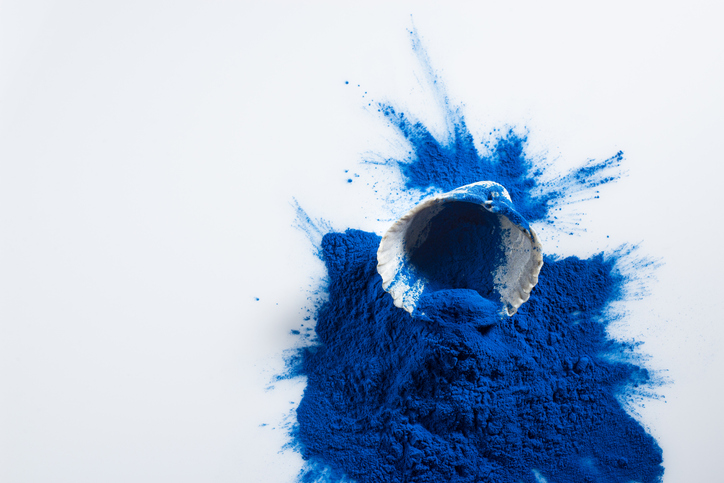
But what gives it this distinctive color? And why is phycocyanin attracting so much interest from researchers?
To understand what makes blue spirulina unique, we first need to look at its composition.
Spirulina, also known by its current scientific name, Limnospira platensis (formerly Arthrospira platensis), is a microscopic cyanobacterium that has long been used as a source of nutrients. It naturally contains several pigments, including chlorophyll and phycocyanin.
Phycocyanin is responsible for its bluish pigmentation and has become an important subject of scientific research.
1. Phycocyanin: The Secret Behind Its Blue Color
Phycocyanin is a protein pigment naturally found in spirulina. It belongs to the phycobiliprotein family and contributes to photosynthesis by absorbing certain wavelengths of light.
It is primarily responsible for spirulina's characteristic blue-green coloration.
Beyond its appearance, phycocyanin is of particular interest to researchers because of its various biological properties.
Antioxidant Activity Studied by Scientists
Phycocyanin has demonstrated antioxidant activity in various laboratory studies.
Antioxidants are compounds that help protect cells against damage caused by free radicals.
Researchers are studying the ability of phycocyanin to neutralize certain reactive species involved in oxidative stress.
A scientific review published in 2024 in the International Journal of Biological Macromolecules examines research on the production, extraction, stability, and applications of phycocyanin.
However, it is important to distinguish between results obtained in laboratory studies and effects that have been directly demonstrated in humans.
Potential Anti-Inflammatory Properties Under Investigation
Phycocyanin is also being studied for its interactions with certain biological mechanisms associated with inflammation.
Preclinical studies have observed promising effects. However, research is ongoing to better understand these mechanisms and their potential relevance to human health.
Phycocyanin therefore remains a particularly interesting compound for scientific research.
2. Why Choose Organic Blue Spirulina?
Product quality is not determined by color alone. The origin of raw materials, cultivation conditions, traceability, and production methods also play an important role.
Choosing certified organic spirulina means selecting a product that meets the applicable organic production and certification requirements.
In Canada, the use of the term "organic" is regulated. Products must contain at least 95% certified organic ingredients to make this claim.
Here are a few factors to consider when choosing organic spirulina:
-
Organic certification: Make sure the product has a valid and recognized organic certification.
-
Ingredient list: Look for clear and transparent product composition.
-
Traceability: Find out where the ingredients come from and how they are produced.
-
Quality control: Look for manufacturers who prioritize product testing and quality controls.
-
Storage: Choose packaging that protects the powder from air, moisture, and light.
At Gandalf, we place particular importance on the quality of our products and the transparency of their ingredients.
3. What Is the Difference Between Blue Spirulina and Green Spirulina?
Although both come from spirulina, these two forms differ in appearance, composition, and uses.
| Characteristics | Green Spirulina | Blue Spirulina |
|---|---|---|
| Color | Dark green | Vibrant blue |
| Pigments | Chlorophyll and phycocyanin | Color primarily associated with phycocyanin |
| Composition | Generally whole biomass | Whole biomass or phycocyanin-rich extract, depending on the product |
| Uses | Dietary supplements and recipes | Dietary supplements and food applications, depending on the formulation |
One important distinction: blue spirulina is not always an isolated phycocyanin extract. Some products are made from whole spirulina, while others use a concentrated extract of its blue pigment.
It is therefore essential to check the ingredient list to understand exactly what the product contains.
4. How to Use Organic Blue Spirulina
Blue spirulina offers several possibilities thanks to its natural color and versatility.
Pigments derived from spirulina are notably used in the food industry to give certain preparations a blue color.
Here are a few culinary applications:
Smoothies : Blue spirulina can be added to a variety of fruit-based preparations to create colorful drinks.
Desserts : Its natural pigmentation makes it interesting for frostings, creams, yogurt-based preparations, and certain desserts.
Beverages : Depending on the product formulation and its permitted uses, it can be incorporated into a variety of colorful beverage creations.
Food Preparations : Spirulina-derived pigments are also being studied as alternatives to certain synthetic food colorings in specific food applications.
In Canada, the use of spirulina extract as a food coloring agent is permitted in certain specific food categories, subject to applicable regulatory conditions.
5. How to Properly Store Blue Spirulina
Phycocyanin is a pigment that is sensitive to various environmental factors. Temperature, light, and pH can affect its stability and lead to a loss of color intensity.
A scientific review published in 2022 in the Journal of Pharmaceutical Analysis specifically examines the factors that influence phycocyanin degradation.
To help preserve your product's quality, a few precautions are recommended:
-
Store the pouch in a cool, dry place.
-
Avoid direct exposure to light.
-
Carefully reseal the packaging after each use.
-
Limit prolonged exposure to air.
-
Follow the manufacturer's storage instructions.
A tightly sealed, light-resistant package helps protect the powder and maintain its quality.
6. Blue Spirulina: An Ingredient Gaining Interest in the Food Industry
Growing interest in naturally derived ingredients is encouraging researchers and manufacturers to explore new solutions for food applications.
Phycocyanin represents an interesting option because of its vibrant blue color and pigment properties.
It is being studied for use in beverages, desserts, and various food preparations.
However, its use presents certain technical challenges, particularly its sensitivity to heat, light, and acidity.
A scientific publication from 2024 in Food Research International examines sources of phycocyanin, its stability, and different strategies that could improve its use in food products.
This research is contributing to the development of new applications for natural pigments.
Discover Gandalf Organic Blue Spirulina
At Gandalf, we are proud to offer spirulina-based products that meet quality and traceability requirements.
Our organic blue spirulina stands out for its natural color and plant-based composition. It reflects our commitment to introducing consumers to the possibilities offered by spirulina and its various compounds.
For over 35 years, Gandalf Spirulina has been dedicated to this remarkable ingredient and its applications.
Want to learn more? Discover our organic blue spirulina and explore its many possibilities.
Discover Organic Blue Spirulina – Gandalf Spirulina
Scientific and Institutional Sources
-
Mao et al. (2024) – A review of phycocyanin: Production, extraction, stability and food applications.
-
Jaeschke et al. (2022) – Physicochemical degradation of phycocyanin.
-
Roussel et al. (2023) – Scientific classification of Limnospira.
-
Canadian Food Inspection Agency (CFIA) – Organic Products Regulations.